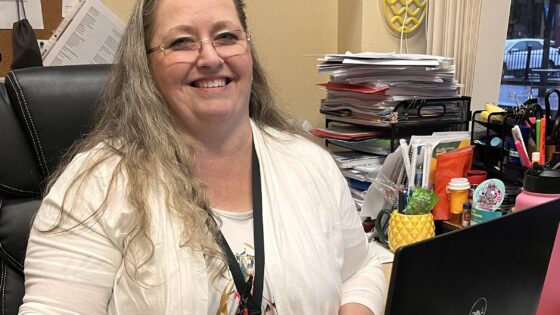
Almost seven years in, what keeps you coming back?
Even if it’s the worst day ever, there’ll be a Resident who makes it worthwhile. It’s the little things, like Leila who will give me a hug every day, or maybe twice a day! Or when someone has just told me, “I’m the worst person to ever walk the earth” just because I was trying to give them pills. And then I turn the corner, and someone else goes, ‘Kelly!’ and is just happy to see me.
It’s the relationships. I do my best to treat Residents like humans. Residents also see me as a person, too, and they care. And it makes all the difference.
What do you get out of this work?
Human connection. Not just with Residents, but with coworkers. Because this is the kind of job you really have to rely on the people you work with. And I don’t want to say, ‘trauma bond’ exactly, but you do create a special bond, going through the same shit together. People outside who’ve never done this work can’t really grasp it.
What can be challenging about working in Direct Care?
Direct care is the most constant in Residents’ lives, so we get the brunt of their behaviors. They’re like, “Oh, you’re whom I’m most comfortable around, so I feel safe and comfortable to act out a little.” I have to be like, “I’m not the one you’re mad at, but okay.”
What gets me sometimes is that in my family, there’s a lot of history of the same things our Residents struggle with, and I just want them to be safe. So sometimes it can be a triggering thing for someone with past personal experience, and that’s a lot.
Who thrives at MacRes?
You’ve got to want to take care of people in the first place. But you’ve also got to have a backbone, to be strong-willed. It’s not all great, wonderful things. You have to be a little dark and have the ability to laugh about the crappy stuff.
Laughing about it doesn’t diminish the seriousness. But if you don’t laugh, you’ll cry. So, you need a strong mindset and also a kind of twisted sense of humor to roll with the punches and laugh about it later.
What keeps you going on the hard days?
On those days, I definitely have my ‘what the hell am I doing? Why am I doing this? I could just go do something else.’ But then I realize I’d hate that even more.
I’m not a big fan of just giving up on people because it sucked one day. So even on the hard days, I still think it’s worth it. I still feel like it’s what I’m supposed to be doing.
I could get another job, but I don’t want to. If today sucks, tomorrow is completely different. That’s the thing about MacRes: every single day is different.
What is the most valuable thing MacRes provides?
We’ve had Residents where it’s obvious they never spoke to anyone when they were out on their own. That human connection, and with it, the empathy and care. Just treating people like humans instead of burdens is so important.
At MacRes, there’s always someone around if they need something, even if it’s at one in the morning.